


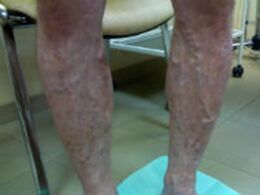
Varicose veins, more precisely varicose veins, is a disease that only affects the venous system.Many consider it a selective foot disease.
But varicose veins occur not only in the lower limbs, but also in the pelvis.At the same time, it manifests itself as hemorrhoids, varicocele (dilated testicular veins), or disguises itself as various gynecological ailments.Esophageal varicose veins associated with cirrhosis of the liver cause many problems for patients.
Causes of varicose veins
The function of the venous system is to ensure that the blood reaches the heart after the useful substances have been used by the tissues, so that the heart sends oxygen to the lungs.The outflow is constant.The negative pressure created by the diaphragm and parts of the heart helps the blood vessels.Since a person spends most of his time in an upright position, the veins must overcome the force of gravity and prevent blood from stagnating.For this, they have a muscular frame and valves on the inner shell.
Varicose veins are the result of venous insufficiency.Violation of the wall structure leads to a loss of elasticity and a decrease in tone.Sluggish valves are unable to hold back blood, and excess deposition (pooling) occurs in distant areas of the body.
Due to the slowing down of blood flow, favorable conditions are created for the adhesion of blood platelets and the formation of blood clots.The situation becomes dangerous as the clot can break off at any time, invade an important blood vessel and cause tissue necrosis.
Another complication is the development of infection in the weakened vein wall (phlebitis).This leads to even more negative symptoms.
Signs of varicose veins are found in every fifth woman and every tenth man.
The causes of the disease are traditionally divided into primary and secondary varicose veins.
- The primary change is related to disturbances in the structure of the vein wall.
- In secondary cases, changes occur in the valve system.
This happens when:
- a hereditary tendency associated with the lack of collagen in the body, which ensures the elasticity of the wall or the components necessary for its synthesis;
- endocrine disorders resulting from long-term use of hormonal drugs (contraceptive pills, steroid drugs);
- heavy physical activity;
- forced long-term working position standing;
- sedentary lifestyle;
- pregnancy;
- smoking;
- leg injuries.
Taking into account the listed factors that contribute to the development of the disease, the risk group can be defined, which includes future varicose vein patients, regardless of age:
- professions requiring long employment (salespeople, teachers, hairdressers);
- motionless posture (drivers, sitting in front of a computer) - stagnation occurs in the legs and pelvis;
- the habit of wearing high-heeled shoes - redistributes body weight and increases the load on blood vessels;
- athletes - weightlifting, bodybuilding, wrestling, tennis put a lot of stress on the legs;
- people wearing tight underwear, tights with rubber bands, belts, belts - any constriction helps to delay the outflow of blood;
- the habit of sitting cross-legged for a long time blocks the superficial veins of the lower leg, promoting stagnation;
- the passion for alcoholic beverages and coffee causes dehydration of the body, accordingly, the blood thickens and slows down the flow through the vessels.
Symptoms of the disease
With varicose veins, the most unfavorable blood circulation conditions are created in the peripheral tissues.Therefore, varicose veins of the legs are the most common manifestation of the disease.
- Pain and fatigue in the legs appear at the end of the working day.
- Burning sensation.
- Cramps while walking or at night.
- Swelling of the legs in the evening, patients note that their usual shoes are too tight.
- The appearance of "vascular spiders" on the legs.
- Darkening and dryness of the skin of the feet and legs.
- Trophic ulcers on the legs.
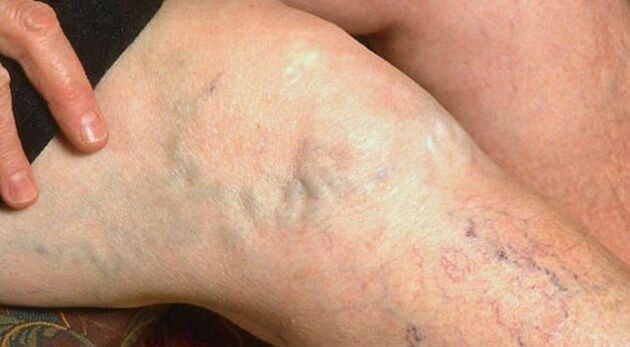
The signs listed above develop gradually over the years.
The appearance of "visible" symptoms indicates progressive vascular damage.
Treatment
Varicose veins therapy cannot rid the patient of the disease, but it helps to prevent serious complications and slow down the further development of the disease.
What habits do you need to break?
When treating varicose veins, ask yourself: "What should you change in your usual life?"The following tips will help:
- stop visiting the bath, steam bath, hot baths are contraindicated;
- limit the consumption of strong alcoholic beverages and beer;
- gradually stop smoking;
- control your posture while sitting, do not cross your legs;
- stop tightening with belts, belts and special underwear;
- get rid of excess weight;
- do not wear tight shoes and high heels;
- Get into the habit of rinsing your feet with cold water at night after you shower, and prop your feet up on a pillow while you rest at home.
Motor mode
Considering the risk factors, it is necessary for those working in "dangerous" professions to take foot massage breaks: drivers get out of the car to walk around, hairdressers sit on a chair and massage their feet from bottom to top with light caressing movements.
You should walk as much as possible, the work of the muscles of the legs promotes the outflow of blood.
Morning exercises should include exercises lying on your back with the legs raised, the toes pulled towards you and the arches of the feet stretched.
Recommended sports include swimming and cycling.
Diet
The choice of foods for varicose veins is related to strengthening the walls of blood vessels, limiting spicy and salty foods that retain fluid.
You should limit the consumption of fatty meat in any form, spicy spices, smoked foods, butter, cheese, mayonnaise, sweets and carbonated drinks.
Include vegetables and fruits, cereals, dairy products, green or herbal tea, vegetable oil, onions and garlic in your daily diet.
Conservative means
To support venous blood flow, it is recommended to bandage the legs from the toes to the middle of the thigh.It is much more comfortable to wear special compression socks.They are sold in the pharmacy chain, they have sizes.The doctor will help you choose knee socks.
Advertised medicines or ointments are effective only in the initial stages of the disease, when a person notices increased fatigue in the legs.The doctor will recommend the most modern and effective medicines.Their use in the "visual" stage is practically useless.
Phlebologists treat varicose veins.It is believed that about 95% of cases can be compensated with low-traumatic methods, only 5% require surgical intervention.
Low trauma methods for the treatment of varicose veins
These procedures require no skin incision at all or involve a small incision.They are performed on an outpatient basis and are painless.The patient does not experience any restrictions and can carry out his usual work.
Laser ablation
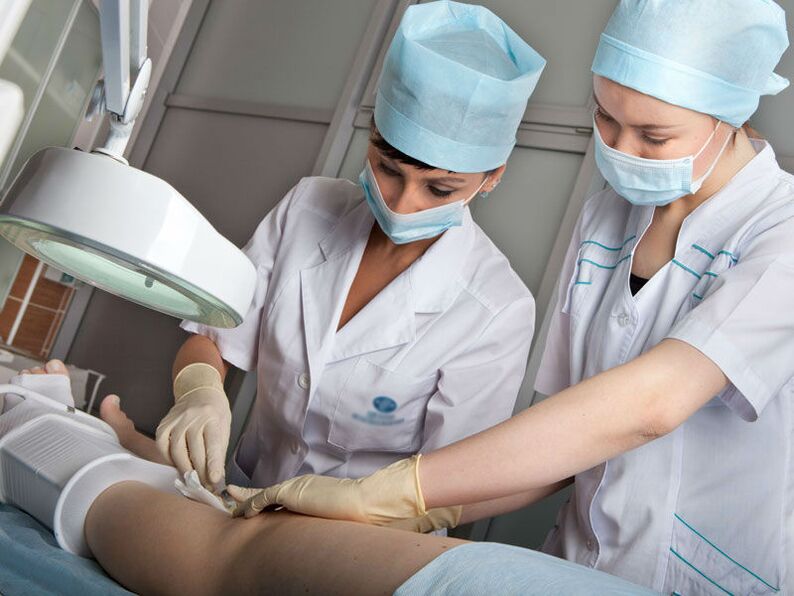
Under local anesthesia, a light guide is carefully inserted into the varicose area and a circular laser is switched on during the reverse movement.The procedure takes a maximum of two hours.The laser beam causes burning of the inner shell with further sclerosis.It is used to treat veins of any diameter.
Sclerotherapy
The patient is injected into the affected vessel with a substance that causes the walls to collapse and then sclerosis.Currently, clinics use foam preparations that are safe for the body.It is used when the diameter is not more than one cm.After the procedure, it is recommended to walk for an hour.You will need to wear compression socks for another month.
Microphlebectomy
After local anesthesia, a small skin incision (up to a few mm) is made, the diseased vein is grasped with a special hook, pulled out and removed.With this method, you can remove any size pot.There will be visible bruising at the incision site for a few days after the procedure.A small scar is formed.Compression socks should be worn for about 10 days.
Radiofrequency ablation
The method is similar to the laser, but here a microwave radiofrequency exposure catheter is introduced into the area of the varicose vein.It is believed to cause no burns and is safe for surrounding tissue.After half an hour of exposure, the lumen of the vessel is "sealed".You can do sports after just one week.
Surgical treatment
The operation to remove an enlarged vein or an entire bundle is called a phlebectomy.It requires hospital treatment.General anesthesia is used.Two skin incisions are made (in the groin and below the knee).The surface branches are tied off.The entire vein is highlighted and excised.After the operation, the patient must be observed in the hospital for about a week.They monitor the condition of the postoperative sutures and prescribe medications that slow down blood clotting to prevent blood clots.Sutures are removed after 7-10 days.
Contraindications to phlebectomy:
- simultaneous damage to superficial and deep veins;
- age over 75 years;
- various skin diseases at the site of surgery;
- oncological diseases;
- pregnancy;
- atherosclerosis of the vessels of the lower extremities;
- severe form of diabetes.
Traditional treatment methods
Traditional methods are best used in the early stages of the disease in combination with drugs.
Hirudotherapy (use of leeches) is an old, proven method.The enzyme secreted by leeches into the blood helps to reduce inflammation and shrinks the walls of blood vessels.
We recommend using decoctions and tinctures made from herbs in the form of poultices in the area of varicose veins.The following are used for this: chamomile flower, calendula, St. John's wort, yarrow, wormwood leaves, horse chestnut, burdock.Nuts and garlic are recommended to be consumed internally.
Choosing the treatment of varicose veins is the task of an experienced surgeon.A timely visit to the doctor and following the recommendations will help prevent serious consequences of the disease.